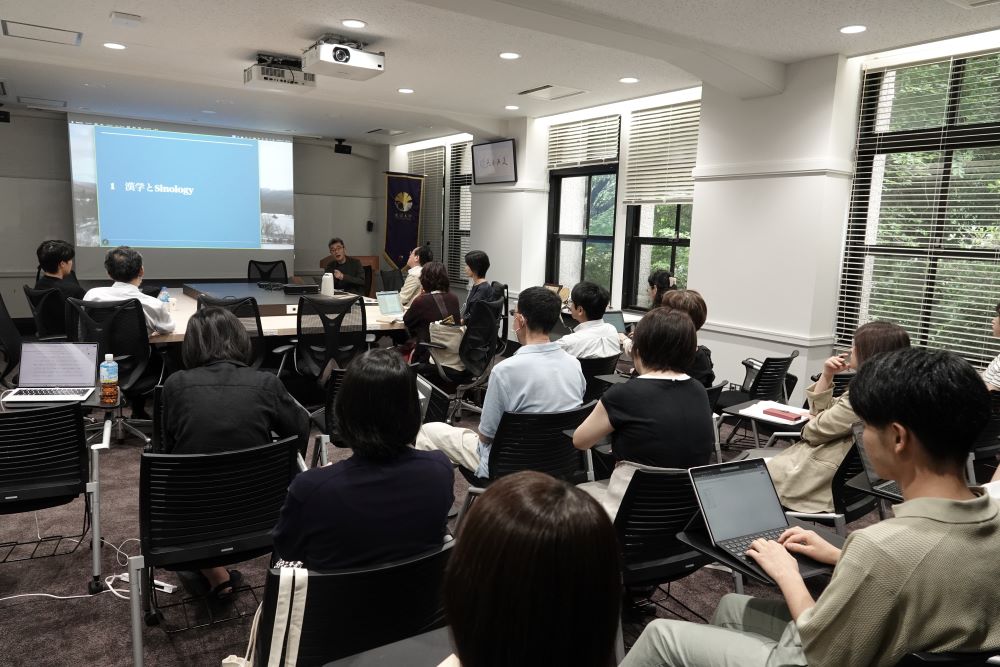
On Wednesday, June 24, 2025, the 7th EALAI Research Seminar, titled “Opening the Possibilities of Planetary Sinology: In Practice with the East Asian Academy for New Liberal Arts (EAA:東アジア藝文書院)”, was held at Room 11, Building 101, Komaba Campus, the University of Tokyo. The speaker was Professor Tsuyoshi Ishii (石井剛:Graduate School of Arts and Sciences, University of Tokyo).
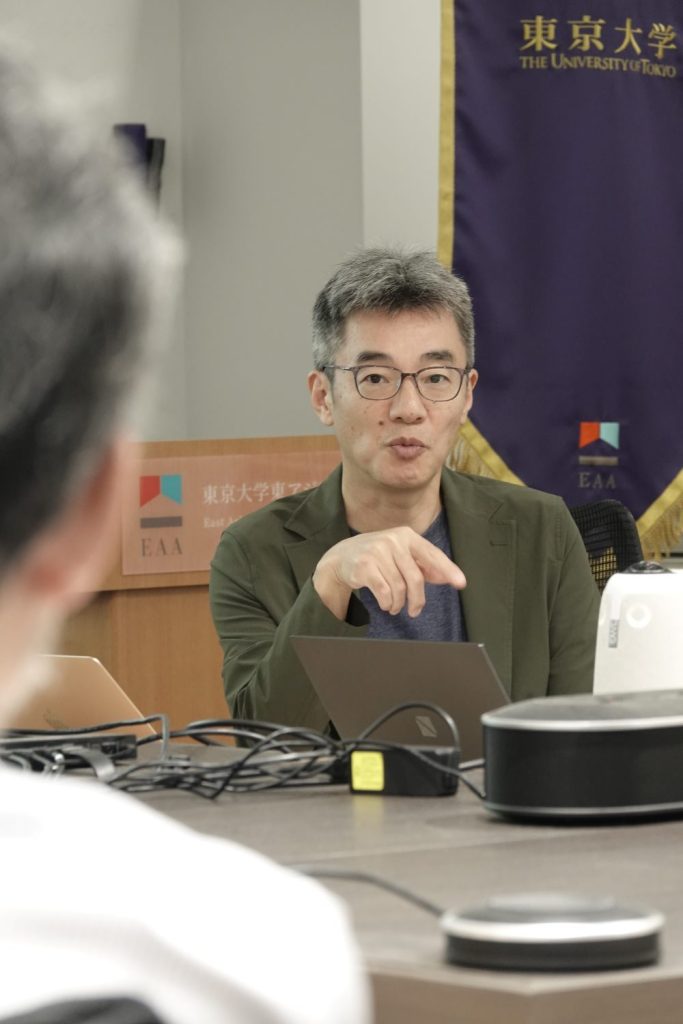
In his presentation, Professor Ishii (EAA) discussed the historical development of Chinese studies and introduced the concept of “Planetary Sinology(惑星漢学)” as a new approach. He began by pointing out that Chinese studies in Japan have historically been conducted under various names such as Kangaku (漢学:classical Chinese studies), Shinagaku(シナ哲学), Chūgokugaku(中国学), and Oriental Studies(東洋学). This diversity of terminology, he argued, has made academic classification difficult.
Ishii emphasized that the term Sinology originally aimed at constructing a universal body of knowledge, not merely area studies. He reexamined the formation of Kangaku in modern Japan, its relation to Chinese classical literature, and the multiple meanings of the terms “China” and “Chinese” from both historical and political perspectives. In particular, he highlighted the ambiguity of the contemporary concept of “China”—including the People’s Republic of China, Taiwan, and overseas Chinese communities—as a key challenge to the traditional framework of Sinology.
To respond to these complex intellectual conditions, Ishii proposed adopting “planetary thinking(惑星的思考).” This approach seeks to counterbalance the modern Western system of universal knowledge through East Asian perspectives. Rooted in liberal arts practices such as close reading of texts, planetary thinking offers a way to reframe knowledge within networks of global interrelations, especially in the face of ecological and climate crises.
He concluded by emphasizing the significance of the EAA, where philosophy, literature, and history intersect, as a space for creating new modes of thought beyond marginal or regional knowledge.
(Zhang Ziyi, PhD student in the Department of Area Studies, Graduate School of Arts and Sciences.)